
Case Study: Front Bumper Mold for European Passenger Vehicle Platform
How Gege Mould engineered a replacement front bumper injection mold with four-side slide mechanisms, full PPAP Level 3, and Cpk ≥ 1.67 — achieving first-shot approval at the OEM's European production facility.
The Challenge
A European OEM required a replacement injection mold supplier for their facelift front bumper program. The existing tooling was approaching end-of-life and producing parts with increasing dimensional variation. The OEM required a complete new mold — not a refurbishment — with full PPAP Level 3 documentation, Cpk ≥ 1.67 on all critical-to-quality dimensions, and first-article delivery within 14 weeks. The bumper fascia incorporated parking sensor housings, lower grille attachment points, and multiple trim clip features — all requiring undercut release mechanisms.
Constraint 1 — End-of-Life Emergency. The existing tooling was producing parts with unacceptable dimensional variation, and the OEM's production line was at risk. This was not a new program launch — it was a running production line that needed a seamless tooling transition without any interruption to vehicle assembly. The 14-week timeline included design, build, tryout, PPAP, and shipment.
Constraint 2 — Complex Undercut Geometry. The fascia incorporated recessed parking sensor housings on the front styling surface, lower grille mounting tabs on the bottom edge, and multiple trim clip slots on the inner returns — all in different planes requiring coordinated slide sequencing with the mold opening stroke. Any mistiming would damage the part or the tool.
Constraint 3 — Full PPAP + Capability Study. The OEM required not just dimensional approval but full statistical capability demonstration — Cpk ≥ 1.67 on all 23 critical-to-quality dimensions, supported by MSA studies, PFMEA with 47 failure modes, and a control plan covering 89 inspection characteristics. This documentation package alone typically takes weeks to compile.
Our Approach
Tool Design: Four-Side Slide Mechanism for Multi-Plane Undercuts
Gege Mould's team designed a four-side slide mechanism synchronized with the mold opening sequence to release all undercut features — parking sensor recesses on the front face, trim clip slots on the inner returns, and lower grille mounting tabs on the bottom edge — without secondary operations. Each slide was independently timed via mechanical cam actuation, ensuring the parking sensor cores retracted before the main parting line opened, while the lower grille slides remained engaged until the ejector stroke. This sequencing eliminated the risk of part damage during ejection that had been a recurring issue with the previous supplier's tool.
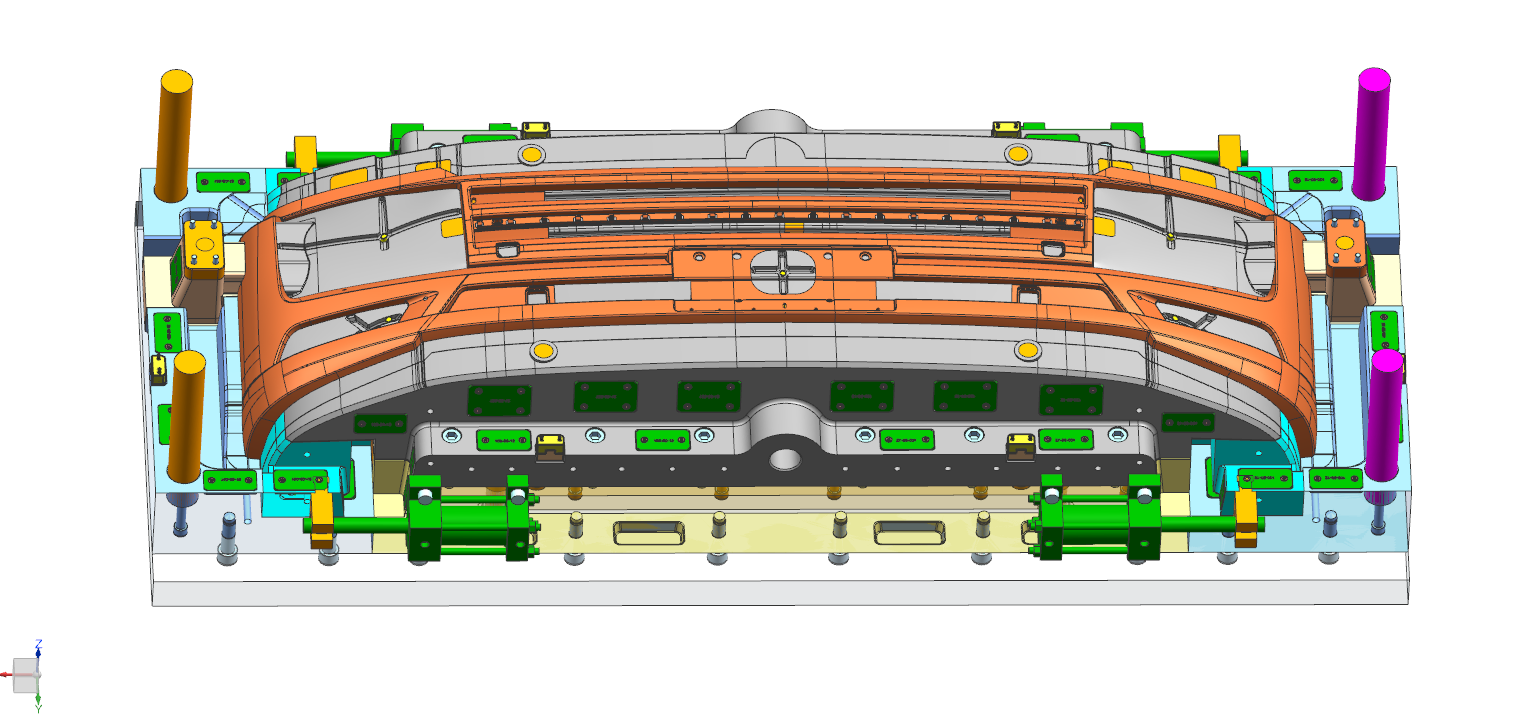
Moldflow: Five Iterations for Balanced Fill
Moldflow simulation was run through five iterations to optimize gate locations for balanced fill across the full 1,750 mm fascia width, ensuring consistent cavity pressure at the extremities and eliminating the risk of short shots or sink marks at the thick-to-thin transitions. The final gate layout positioned six drop points along the lower grille opening, using the grille itself as a natural flow leader to distribute melt evenly across the fascia — an approach that eliminated the need for a hot-runner manifold and reduced tooling cost while maintaining fill consistency within 3% cavity-to-cavity variation.
PPAP: Built Incrementally, Not Compiled at the End
The complete PPAP package — PFMEA addressing 47 potential failure modes, control plan with 89 inspection points, MSA studies on all measurement systems, and capability analysis demonstrating Cpk values between 1.72 and 2.14 across all critical dimensions — was built incrementally throughout the tool build, not compiled after the fact. Dimensional reports were drafted during in-house tryout, PFMEA and control plans were reviewed with the customer at the design review milestone, and capability data was collected from the T1 sampling run rather than waiting for production stabilization.
The Results
What This Program Taught Us
- Replacement tooling programs have zero schedule float. When a production line is running and the existing tool is failing, the replacement mold must be delivered on time — not a day late. This changes every decision: tool steel selection must account for availability, machining must happen on dedicated capacity, and tryout must be scheduled before the tool is even finished.
- Multi-plane slides need independent timing, not just synchronized actuation. Different undercut features release at different points in the mold opening stroke. Designing each slide with its own cam profile — rather than ganging them together — prevents interference and part damage during ejection.
- PPAP is a parallel workstream, not a final deliverable. Compiling the PPAP package incrementally — PFMEA at design review, dimensional reports at T1, capability data from the sampling run — means documentation is complete when the tool ships, not weeks afterward. This is how you achieve PPAP sign-off within three weeks of delivery.
About this case study: This case study is based on a real front bumper mold program completed by Gege Mould for a European OEM. The program scope, engineering approach, and outcomes described reflect actual project experience. Specific customer and part details have been generalized where necessary to respect client confidentiality.
Have a Large-Format Bumper or Exterior Fascia Program?
If you're sourcing injection molds for large-format exterior automotive panels and need a partner who delivers PPAP-ready tooling on time — with documented process capability — contact our engineering team for a program review.
Start Your RFQ