
Case Study: Heavy-Duty Truck Door Panel Mold — Multi-Cavity Hot-Runner System
How Gege Mould engineered a 2-cavity injection mold for a next-generation heavy-duty truck door inner panel — Class-A grained surface, sequential valve gating, and 500,000+ shot service life — delivered two weeks ahead of schedule with zero dimensional deviations.
The Challenge
A European Tier 1 supplier to a major heavy-duty truck OEM approached Gege Mould with an urgent requirement: a 2-cavity injection mold for a next-generation door inner panel. The part measured approximately 1,100 × 750 mm — significantly larger than a typical passenger vehicle door panel — with a Class-A grained surface finish required across the entire visible face. The existing supplier had failed to meet quality thresholds after multiple sampling rounds, and the customer was facing a production line shutdown if tooling wasn't delivered within 18 weeks.
Constraint 1 — Aggressive Timeline. The customer needed the mold delivered, installed, and producing qualified parts within 18 weeks — a compressed schedule for a tool of this size and complexity, especially given the Class-A surface finish requirement. The previous supplier had already consumed months without a viable mold, leaving no schedule float.
Constraint 2 — Class-A Grained Surface. The entire visible face of the door panel required a consistent grained finish with no visible transitions at shut-offs, parting lines, or gate locations. Any grain mismatch or witness line would be immediately visible to the end customer — the truck driver and passenger — making this a zero-tolerance aesthetic requirement.
Constraint 3 — Production Longevity. The tool needed to deliver 500,000+ shots over its service life while maintaining dimensional stability and surface quality. This ruled out lower-cost tool steels and demanded careful material selection and heat treatment strategy from the start.
Our Approach
Engineering & DFM: Finding the Gate Position Before Cutting Steel
Gege Mould's engineering team began with a comprehensive DFM (Design for Manufacturing) analysis of the customer's part model. Moldflow simulation revealed that the original gate locations specified by the previous supplier would create visible weld lines on the primary styling surface. Our team repositioned the gates along the belt-line — a natural visual break in the part — using sequential valve gating to ensure melt fronts met precisely at the parting line rather than on an exposed surface.
Pre-hardened 718H tool steel was selected for both cavity and core, providing sufficient hardness for the 500,000+ shot service life target without the lead-time penalty of full hardening. All grained surfaces — including shut-offs and parting lines — were machined to the same grain specification so no visible transition would appear on the finished part. This attention to grain continuity is something many tool shops overlook, but on a part where the entire visible surface is grained, it's the difference between a first-shot approval and months of texture rework.
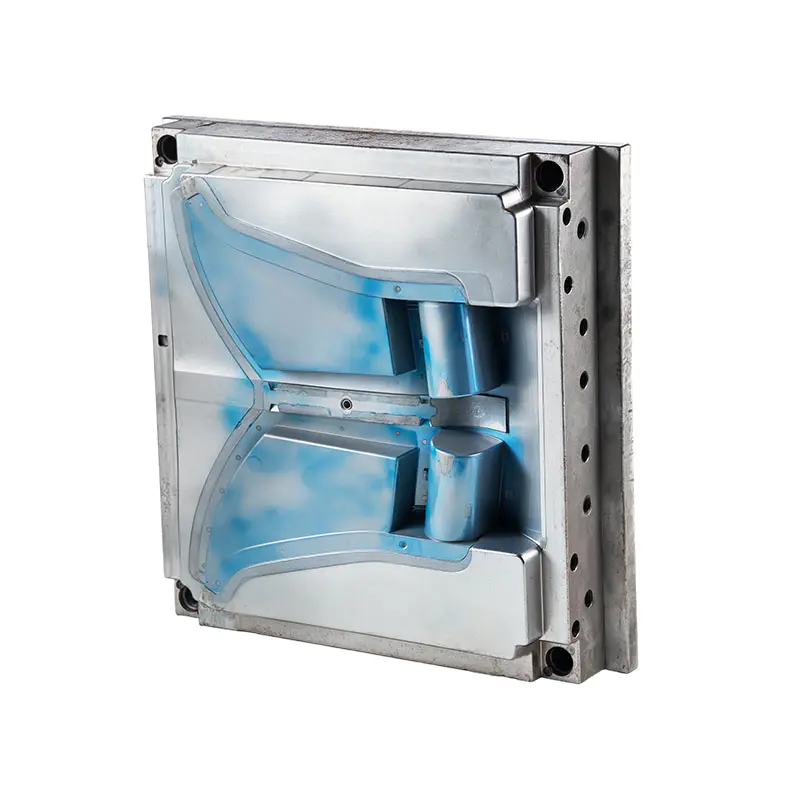
Hot-Runner System: Sequential Valve Gating for Surface Quality
A critical engineering decision was the hot-runner configuration. For a part this large with a Class-A visible surface, conventional cold-runner gating would have left gate vestige on the visible face — unacceptable for the customer's quality requirements. Gege Mould engineered a hot-runner system with sequential valve gating that precisely controlled the melt front advance, allowing weld lines to be positioned along the belt-line parting line where they were invisible to the end user. This approach added upfront tooling cost but eliminated the need for post-molding gate trimming and surface rework on every single production part.
The Results
What This Program Taught Us
- DFM before steel is non-negotiable. Running Moldflow before cutting steel identified gate position issues that would have caused weld lines on the visible surface — a problem the previous supplier discovered only at sampling, by which point it was too late to recover the schedule. DFM is the cheapest insurance a mold program can buy.
- Grain continuity across shut-offs and parting lines requires upfront planning. Specifying the grain on the cavity is standard. Specifying and machining the grain on shut-offs and parting lines in the same setup is what separates production-ready tooling from tools that need months of texture rework at sampling.
- Schedule recovery is possible but only with parallel engineering. Taking over a failed program mid-stream meant we had zero float. Running design, machining, and tryout in overlapping phases with dedicated capacity was the only way to meet the customer's fixed production start date — and we delivered two weeks early.
About this case study: This case study is based on a real door panel mold program completed by Gege Mould for a European Tier 1 heavy-duty truck supplier. The program scope, engineering approach, and outcomes described reflect actual project experience. Specific customer and part details have been generalized where necessary to respect client confidentiality.
Discussing a Door Panel or Large Interior Trim Mold Program?
If you're sourcing injection molds for large-format interior or exterior automotive panels and need a partner who delivers on time and on spec — with full PPAP documentation — contact our engineering team for a program review.
Start Your RFQ