
Case Study: HVAC Blower Housing Mold — High-Temperature PP-GF30
How Gege Mould engineered an injection mold for a glass-fiber-reinforced PP blower housing — H13 nitrided steel for abrasion resistance, collapsible core eliminating secondary machining, and conformal cooling for reduced cycle time.
The Challenge
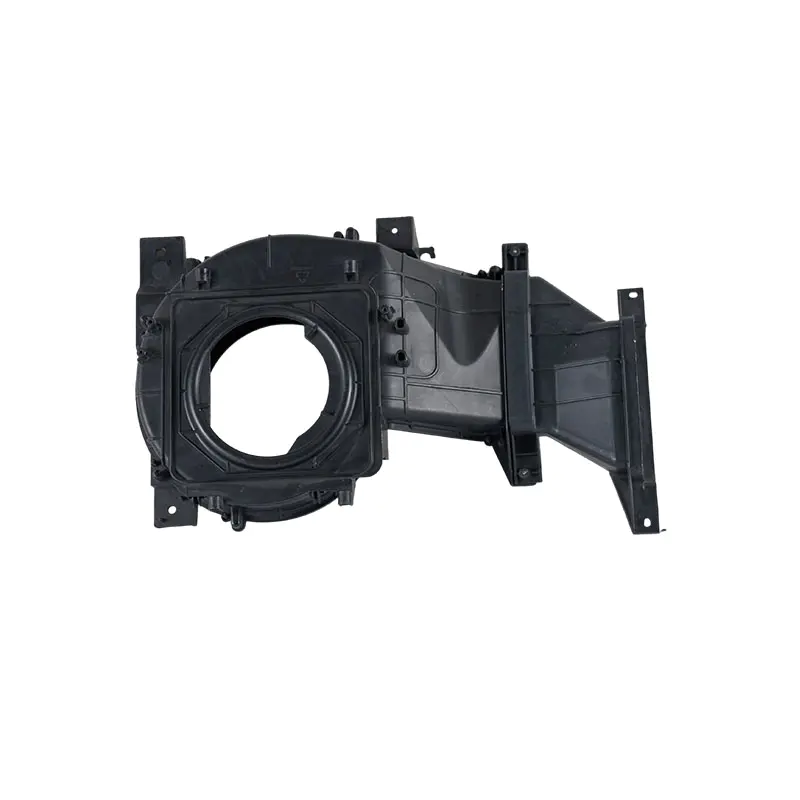
A Tier 1 HVAC systems supplier approached Gege Mould seeking a more cost-competitive tooling source for a blower motor housing mold. The part was molded in PP-GF30 — a glass-fiber-reinforced polypropylene known for elevated abrasiveness that accelerates cavity wear in non-optimized tool steels. The housing featured complex internal geometry with deep undercuts for air-flow guide vanes and snap-fit assembly features, all of which traditionally required secondary CNC machining after molding. The customer's production schedule demanded 150,000 units annually with consistent dimensional quality across the full production run.
Constraint 1 — Material-Driven Tool Wear. PP-GF30 contains 30% glass fiber by weight — a formulation chosen for elevated heat deflection temperature and dimensional stability at under-hood temperatures. However, glass fibers are highly abrasive during injection, eroding cavity surfaces and causing dimensional drift over the production run. The incumbent supplier's P20 tooling was showing measurable wear after 80,000 shots, requiring cavity rework during scheduled PM that added cost and downtime.
Constraint 2 — Deep Internal Undercuts. The blower housing's internal volute geometry — the spiral air passage that gives the blower its efficiency — created severe undercuts that could not be formed with conventional straight-pull tooling. The previous supplier's approach used three separate secondary CNC operations to machine the volute after molding, adding approximately 22% to the per-part cost and creating a bottleneck in the production cell.
Constraint 3 — Thermal Uniformity in a Complex Core. The internal core for the volute geometry was thermally isolated from the mold base, making it prone to hot spots that extend cycle time and cause warpage in semi-crystalline PP. Conventional straight-drilled cooling channels could not follow the spiral volute geometry, resulting in non-uniform cooling and inconsistent part dimensions between the inner and outer volute walls.
Our Approach
Material Selection: H13 + Nitriding for Glass-Fiber Abrasion
Recognizing the abrasion challenge of 30% glass-fiber-filled PP, Gege Mould specified H13 hot-work tool steel for both cavity and core — significantly more wear-resistant than the P20 previously used by the customer's incumbent supplier. H13 offers higher hot hardness and better resistance to the erosive wear mechanism caused by glass fiber flow across cavity surfaces. All cavity surfaces received a nitriding treatment to further harden the surface layer to approximately 68 HRC at a case depth of 0.15 mm, creating an extremely hard, wear-resistant skin over the tougher H13 substrate — combining abrasion resistance with the toughness needed to survive millions of injection cycles without chipping or cracking.
Collapsible Core: Eliminating Three Secondary Operations
The most significant engineering contribution was a collapsible core mechanism that formed all internal undercut features — the spiral volute passage, snap-fit tabs, and assembly locators — in the mold itself, eliminating three secondary machining operations. The collapsible core was designed with six radially expanding segments that retracted inward during ejection, releasing the undercut geometry without part distortion. This approach reduced per-part cycle time by approximately 22% compared to the molding-plus-CNC process, and eliminated the production bottleneck created by secondary machining capacity constraints. For the customer, this meant one production cell instead of two, and one operator instead of three.
Conformal Cooling: 3D-Printed Inserts for Thermal Uniformity
Conformal cooling channels, designed using thermal FEA simulation, followed the complex core geometry at a consistent 8–10 mm standoff distance from the molding surface. Unlike conventional straight-drilled cooling, which creates hot spots in complex geometries, the conformal channels maintained uniform heat extraction across the entire volute surface — critical for consistent part dimensions in semi-crystalline PP, where cooling rate directly affects crystallinity and shrinkage. The conformal cooling reduced cycle time by 12% compared to conventional straight-drilled cooling in the same part geometry, while simultaneously improving dimensional consistency — a rare combination where productivity and quality improve together.
The Results
What This Program Taught Us
- Material selection must be driven by the molding material, not just part geometry. PP-GF30 is a different world from unfilled PP — the glass fibers are abrasive, and tool steel selection must account for that. H13 + nitriding was the right choice here, and the 200,000-shot wear inspection proved it. The customer's tooling cost increased marginally but their cost-per-part dropped significantly — a net savings over the tool's service life.
- Collapsible cores pay for themselves within the first year of production. The upfront cost of a collapsible core mechanism is higher than a straight-pull core. But eliminating three secondary machining operations — each requiring a CNC machine, an operator, and floor space — recovers that investment within months, not years. For annual volumes above 100,000 units, collapsible core tooling should be the default approach for any part with internal undercuts.
- Conformal cooling is a productivity tool, not just a quality tool. The 12% cycle time reduction from conformal cooling was achieved while simultaneously improving dimensional consistency. In high-volume production, a 12% cycle time reduction translates directly to increased capacity without additional capital expenditure — the most valuable kind of efficiency gain in injection molding.
About this case study: This case study is based on a real HVAC blower housing mold program completed by Gege Mould for a Tier 1 HVAC systems supplier. The program scope, engineering approach, and outcomes described reflect actual project experience. Specific customer and part details have been generalized where necessary to respect client confidentiality.
Looking for a More Cost-Competitive Tooling Source for Functional Parts?
If you're sourcing injection molds for glass-fiber-reinforced, high-temperature, or technically demanding functional components — and want tooling that reduces your per-part cost, not just your tooling cost — contact our engineering team.
Start Your RFQ